Best manga for Japanese beginners
You’re fairly new to learning Japanese, and you’re looking for a suitable manga to read.
Plenty of “top 10” lists have been compiled, but these are necessarily generic. They cannot factor in each reader’s likes and preferences.
Do you want or have you decided?
When you’re learning Japanese and looking for manga to read, there’s an important distinction you need to make.
Do you want to read manga in Japanese?
Or have you decided you will read manga in Japanese?
Everyone has numerous things they want, but this is a superficial desire if they are not putting in the time and effort to get them. Wanting alone doesn’t get you anywhere.
Once you’ve decided to do something, you’ve determined that nothing will get in your way, nothing will deter you, nothing will discourage you.
If you haven’t decided that you will read manga in Japanese, then those top 10 lists of beginner-friendly manga will be indistinguishable from a list of manga so hard that even native speakers struggle with it.
Understand that you’ll be deciphering rather than reading. Get comfortable with tolerating ambiguity.
And then make the decision that you will read manga in Japanese.
You can pick any manga as your first, and use it as a guide to learning more Japanese grammar, vocabulary, kanji, and idiomatic expressions.
Selecting an appropriate manga
Just because you can start with a difficult manga doesn’t mean you should. It’s still a huge time and learning commitment, and finding something easier can help you see steady progress.
If you’re not too picky about the content and want to ease into it, there are a few things you can look for:
Furigana. Don’t waste time looking up words you know but haven’t learned the kanji for yet.
Low word density. Check the volume one preview on BOOK☆WALKER and see if the number of words looks reasonable. If the series is on Manga Kotoba, you can get a measure of the word density there (aim for below 10).
Low unique vocabulary count. Use a site like Manga Kotoba to see how many words a volume contains. Aim for something below 1,000 unique words and 1,500 total words per volume.
Simple setting. Slice-of-life content is recommended because it often doesn’t involve complex scenarios and uncommon genre-specific vocabulary.
My recommendations
Here’s my short recommendation list, based on what I’ve read:
あしたは土曜日
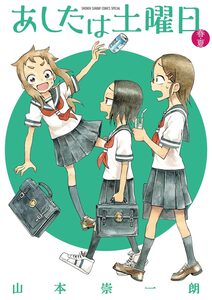
Each chapter is an independent five-page story. You don’t have to worry about losing track of context, and it’s easy to go back and re-read a chapter.
If you enjoy the content and want more after finishing the two volumes, you can jump into the sister series, 「からかい上手の高木さん」. The increase to 16-page chapters should help you build your ability to follow what’s going on across a longer scene.
And once you’ve reached volume five of that, you can add 「からかい上手の(元)高木さん」 to your line-up for easy eight-page stories. Being able to jump back and forth between a more difficult series and an easier one helps gives you visibility to your progress.
Just be careful not to burn out on the setting and characters. It doesn’t hurt to take a break from one series and pick up something completely unrelated to work through.
ちいさな森のオオカミちゃん
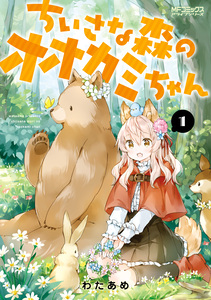
A slice-of-life around anthropomorphized animals living in a forest.
The primary draw for this series is the low unique vocabulary count. Some readers will find the content too simple to be engaging, whereas others will find it enjoyable because they can understand it easily.
Although the setting is slice-of-life, chapters occasionally refer back to prior events.
レンタルおにいちゃん

The story follows a young girl who rents an older brother, bringing joy against her tragic home life and school situations.
This series has a fairly low unique vocabulary count per volume. A small time investment in pre-learning the most common vocabulary words goes a long way.
Unlike most slice-of-life series, this one presents clear objectives for the main characters and takes the reader along for all the ups and downs.
The grammar steadily increases in difficulty through the four volumes. The only concern for a first-time reader is volume two’s introduction of an occasional character who speaks in the Kansai dialect.
耳をすませば
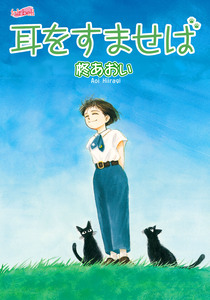
Recognizable to many from its Studio Ghibli animated adaptation, this single-volume series is set in a high school and has fairly simple scenarios.
Unlike my other recommendations, this one isn’t so much for first-time as for when you’re ready to start reading material without furigana. This series has partial furigana, leaving it off of the most common kanji.
Being a one-off story, there’s a very low commitment.
Conclusion
Reading native material is hard.
Diving into your first manga in Japanese is no exception. It’s unavoidably overwhelming.
Going into it with the right mindset and a carefully chosen series, it becomes an enjoyable and rewarding way to improve your growing Japanese skills.
Progress doesn’t happen overnight. It requires consistency and a willingness to embrace challenges.
Choose a manga that genuinely interests you. Be patient with your learning process. Celebrate small victories along the way.
With each chapter, your reading comprehension will steadily grow, and your confidence along with it.
And before you know it, you’ll be reaching for volume two.