Challenge deadline with 期限
Vocabulary Explanation: Predetermined fixed time with 期限
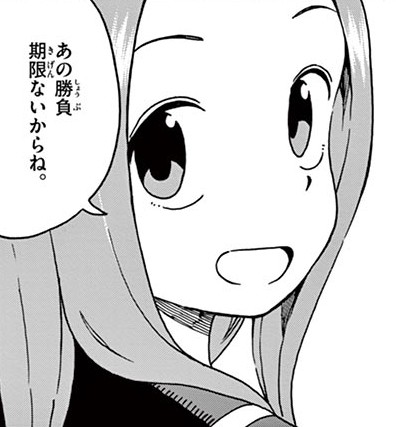
During their walk home after school, Takagi presents Nishikata with an impossible challenge. When he pushes back against it, she comes up with a new challenge, which Nishikata loses. As the two reach the point where they part ways, Takagi stops for a moment.
- 高木:
- 「あの勝負期限ないからね。」
- “There's no deadline for that challenge.”
Key Points
- 期限= “deadline” (a fixed time limit)
- 期限 is a predetermined, fixed time limit (often best translated as “deadline” in everyday contexts)
- Casual omission: 期限(が)ない
- 期限ない is a casual spoken shortening of 期限がない (the subject marker が is omitted)
- In full form, the idea is: あの勝負に 期限がない → “That challenge has no deadline.”
- Implied particles and spoken “punctuation”
- Natural speech often inserts a pause: あの勝負、期限ないからね。
- That pause helps listeners parse it as “That challenge — there’s no deadline (for it).”
- The sentence also omits an explicit target particle like に / には after 勝負
- あの勝負: shared reference (“that challenge we’re talking about”)
- あの + noun points to something already known in the conversation/context (“you know, that …”)
- 勝負 literally means “match/contest”, but in context it naturally extends to “challenge/bet” with win/lose stakes