Limited amusement park admission with 入場制限
Kanji Explanation: Boundaries and limits with 限
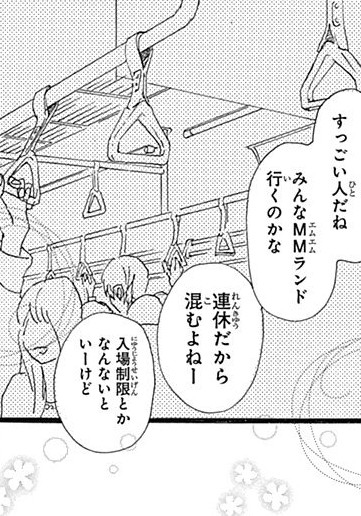
Takeo and his friends board the train bound for the amusement park, MM Land.
- 凛子:
- 「すっごい人だね。みんなMMランド行くのかな」
- “There's a lot of people here. I wonder if everyone's going to MM Land.”
- 隼人:
- 「連休だから混むよねー」
- “It's a long holiday, so it'll be crowded.”
- 愛:
- 「入場制限とかなんないといーけど」
- “I hope they don't restrict admission or anything.”
Key Points
-
入場制限 = “admission restriction”
-
入場 means “entering” or “admission” (to a venue)
-
制限 means “restriction” or “limit”
-
Together, 入場制限 refers to limiting the number of people allowed to enter, commonly used for crowded venues like amusement parks, concerts, or events
-
-
Casual contractions: なんない and といー
-
なんない is the casual spoken form of ならない (negative of なる “to become”)
-
といー is the casual form of といい (“it would be good if / I hope”)
-
Full form would be: 入場制限とかならないといいけど
-
-
とか adds vagueness (“or anything”)
-
とか after a noun means “things like” or “or something/anything”
-
Here it shows Ai isn’t just worried about admission restrictions specifically, but that and similar problems
-
-
Sentence-ending けど softens the statement
-
The けど at the end doesn’t mean "but" here; it’s a softening particle that shows concern or leaves the thought open
-
Makes the statement sound less direct and more like casual worry shared with friends
-