Thought I would see her face with 〜ようと思う
Grammar Explanation: Thinking of doing with 〜ようと思う
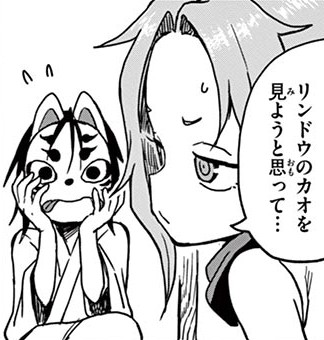
Seeing Rindou asleep, Sazanka reaches for her mask. Rindou wakens and backs away. Tsubaki asks what they’re doing so early in the morning.
- サザンカ:
- 「リンドウのカオを見ようと思って…」
- “I thought I wouldsee Rindou's face...”
Key Points
- 見ようと思って = “I was thinking I’d try to see / get a look at it”
- Pattern: [verb volitional form] + と思う → “think / intend to do [verb]”
- Here 見ようと思って explains Sazanka’s immediate intention just before Rindou woke up
- The volitional 見よう (from 見る) does not mean simple future here; it shows “I was about to / I was thinking I’d…”
- 思って… trails off as an explanation or excuse
- “思って…” leaves the sentence unfinished, like “…that was what I was trying to do”
- Ending in て makes the line sound softer and more sheepish than a firm, fully closed と思った
- Non-past form, past intention
- Even though the pattern is based on と思う, the line refers to what Sazanka was thinking a moment earlier
- In conversation, 〜ようと思って is very natural when giving the reason for an action that was just underway
- Learners may expect a fully past 〜ようと思った, but the て form fits better when the explanation connects directly to what happened next
- カオ in katakana adds a casual, manga-like feel
- 顔 is written as カオ for stylistic effect rather than a change in meaning
- Katakana can make an everyday word feel more blunt, playful, or visually emphasized in dialogue