Training for a judo match with 稽古
Vocabulary Explanation: Training with 稽古
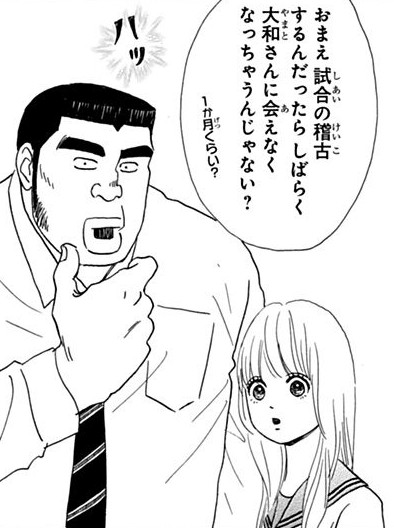
Members of the judo team plea for Takeo to help them in their upcoming match against a rival high school. Takeo quickly accepts their request, but Sunakawa considers how this will impact Takeo’s new relationship with Yamato.
- 砂川:
- 「おまえ試合の稽古するんだったら しばらく大和さんに会えなくなっちゃうんじゃない? 1か月くらい?」
- “When you're training for the match, won't you be unable to see Yamato for a while? For about a month.”
Here, 稽古 is used to describe training for a judo match.
Key Points
-
稽古 = “training” (specifically for martial arts / traditional arts)
-
稽古 refers to disciplined, structured training in martial arts and traditional arts
-
Unlike 練習 as general practice, 稽古 emphasizes learning from past techniques and traditional methods
-
Pattern: 試合の稽古をする → “to train for a match”
-
-
Conditional form: ~するんだったら
-
~んだったら is a casual conditional meaning “if you’re going to~” or “when you~”
-
Here: 試合の稽古するんだったら → “if you’re going to train for the match”
-
-
Negative potential + contraction: 会えなくなっちゃう
-
会えなくなっちゃう is a casual contraction of 会えなくなってしまう
-
Pattern: [potential negative form] + なる → “to become unable to~”
-
The ちゃう (from てしまう) adds a sense of regret or unfortunate outcome
-
-
Seeking confirmation: じゃない?
-
じゃない? at the end of a sentence seeks confirmation or agreement
-
It’s casual and can be translated as “won’t you?” “don’t you think?” or “right?”
-
The speaker (Sunakawa) is prompting Takeo to consider the situation
-