Want you to let me explain with 〜させてほしい
Grammar Explanation: Want you do to something with 〜てほしい
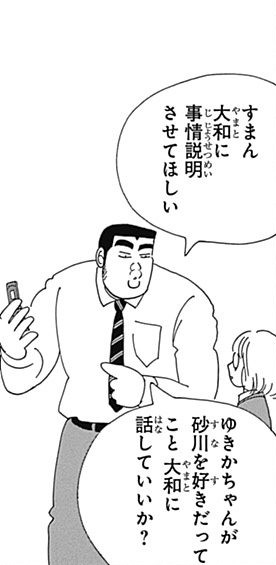
Takeo tries helping the girl who likes his friend Sunakawa. When Takeo receives a call from his own girlfriend, he realizes he’s alone with another girl.
- たけお:
- 「すまん大和に事情説明させてほしい」
- “Sorry, I'd like you to let meexplain the situation to Yamato.”
- 「ゆきかちゃんが砂川を好きだってこと大和に話していいか?」
- “Is it all right if I tell Yamato you like Suna?”
Note: Takeo calls Sunakawa “Suna”, which is why the furigana on 砂川 is すな.
Key Points
-
させてほしい = “I want you to let me…”
-
This combines the causative form させる (“to let/make [someone] do”) with 〜てほしい (“I want you to…”)
-
Pattern: Causative verb + てほしい → “I want you to let me [do X]”
-
Here, 説明させてほしい means “I want you to let me explain”
-
-
Breaking down the causative: 説明する → 説明させる
-
The base verb is 説明する (“to explain”)
-
Causative form: 説明させる → “to let/make [someone] explain”
-
Adding 〜てほしい directs the request to the listener: “(I want) you to let me explain”
-
-
Implicit subject and object
-
The speaker (Takeo) wants permission from the listener to explain something
-
Full thought: “(You) let me explain [the situation] to Yamato; that’s what I want”
-
The に in 大和に marks Yamato as the recipient of the explanation
-
-
Polite urgency with すまん + させてほしい
-
Starting with すまん (“sorry”) softens the request and shows awareness of the inconvenience
-
This makes させてほしい feel more like “please allow me to…” rather than a blunt demand
-