Mutuality and appearance with 相
The etymology of 相 suggests a meaning of to observe or look closely.
From the idea of carefully looking and judging what you see, 相 naturally extends to appearance and aspect (the “way something looks”). In compounds, it is also widely used for mutual relationships (like “with each other”) and for ministers or high officials.
Etymology
This kanji is an ideogrammic compound comprised of 木 (tree) and 目 (eye). It depicts an eye looking at a tree, expressing the idea of examining something by sight: to see, to observe, and to judge.
From that concrete act of seeing comes the more abstract sense of appearance or aspect: what is visible on the surface, or the “state of things” as it presents itself. By extension and borrowing in Sino-Japanese vocabulary, 相 is also used in words for mutual actions (doing something “to each other”) and in titles like 首相 where it means a minister.
Common Words
真相: Truth
真相 means the truth of a situation: what really happened, or the real state of affairs behind appearances.
It combines 真 (true) with 相 (aspect) to show the true aspect of something.
Truth behind the murders with 真相
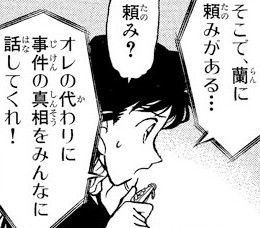
Conan determines the culprit in a series of murders. However, thre’s no one around he can use as a conduit for revealing his reasoning. When Ran scolds Conan for wandering around, he accidentally drops an item Professor Agasa made for him, a wireless phone in the form of a large earring. As Ran picks it up, Conan hides and using his bowtie voice changer to sound like Shin’ichi as he calls Ran on the earring phone. He explains that Conan filled him in on the details.
- 新一:
- 「そこで、蘭に頼みがある…」
- “So with that, I have a favor to ask of you...”
- 蘭:
- 「頼み?」
- “A favor?”
- 新一:
- 「オレの代わりに事件の真相をみんなに話してくれ!」
- “In my place, tell everyone the truth of the situation!”
相談: Consultation
相談 means consultation or discussion with the goal of reaching a decision, getting advice, or solving a problem. Rather than just “talking”, it implies bringing something to someone to think through together.
It combines 相 (mutual) with 談 (talk) to show talking something over together.
Consult us first with 相談
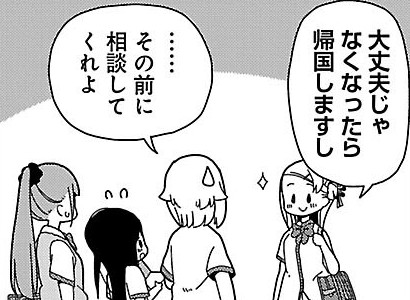
While staying in Japan, Sotoka lives alone in the apartment building her parents own. Aru asks if Sotoka isn’t lonely living alone, but Sotoka says it’s all right.
- ソトカ:
- 「大丈夫じゃなくなったら帰国しますし」
- “If it gets bad, I'll return to my home country.”
- なこ:
- 「……その前に相談してくれよ」
- “Before that, consult us first!”
相当: Corresponding
相当 means “corresponding to” or “appropriate for”.
It combines 相 (mutual) with 当 (appropriate) to show mutually appropriate.
Corresponding letters of the alphabet with 相当
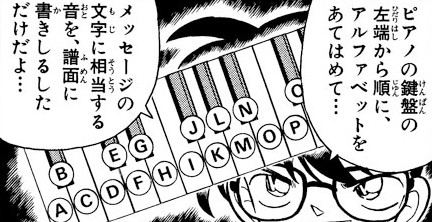
Following a series of murders, Conan discovers a message hidden in sheet music. He explains it to Ran.
- コナン:
- 「ピアノの鍵盤の左端から順に、アルファベットをあてはめて…」
- “Starting from the leftmost key on the piano keyboard, I assigned each key a letter...”
- 「メッセージの文字に相当する音を、譜面に書きしるしただけだよ…」
- “I simply wrote down the notes corresponding to the letters of the message on the sheet music...”
相当: Considerably
相当 can be used adverbially to mean “quite” or “considerably” (as in “to a considerable degree”).
A pretty clean room with 相当
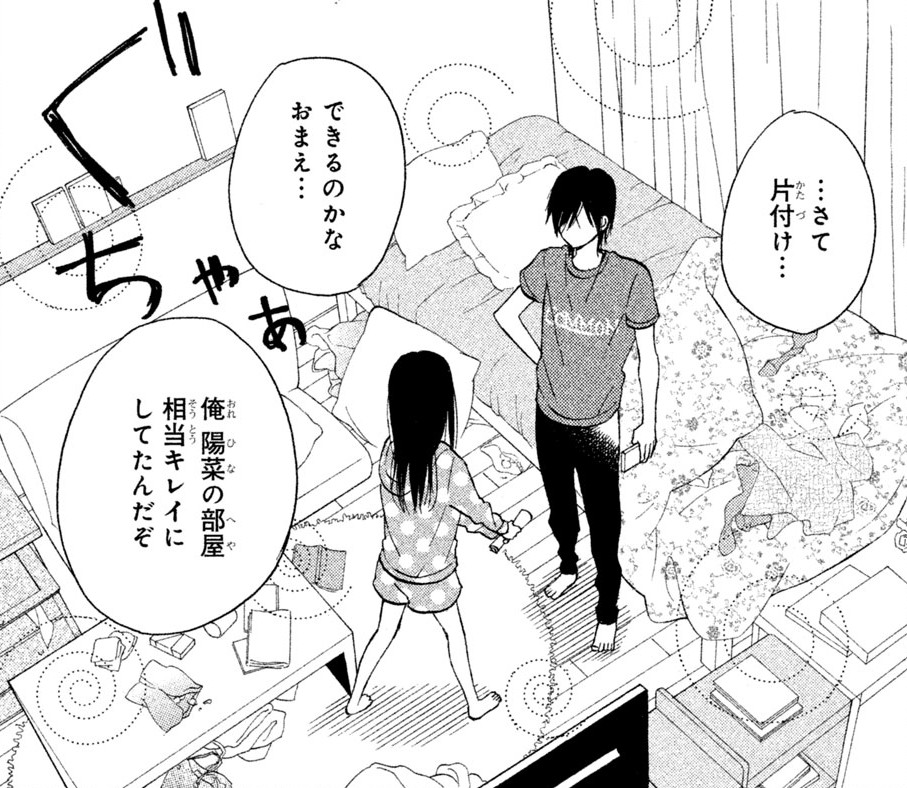
Hiro lets Mao move into his sister’s bedroom, as Hina is living with relatives. After, he comes up with a list of rules that Mao needs to follow if she’s to keep living there.
- 基:
- 「…さて 片付け…」
- “Now then, cleaning...”
- 「できるのかな おまえ…」
- “I wonder if you can do it.”
- 「俺 陽菜の部屋相当キレイにしてたんだぞ」
- “I kept Hina's room pretty clean, you know.”
相当 is used adverbially here.
相性: Compatibility
相性 means compatibility, especially how well two people (or a person and something) “fit” together. It can be used for romantic compatibility, teamwork, and even things like “this pen doesn’t work well with this paper”.
It often implies something that becomes clear through interaction, not just on paper.
It combines 相 (mutual) with 性 (nature) to show the nature between two things (their compatibility).
Compatability fortune with 相性
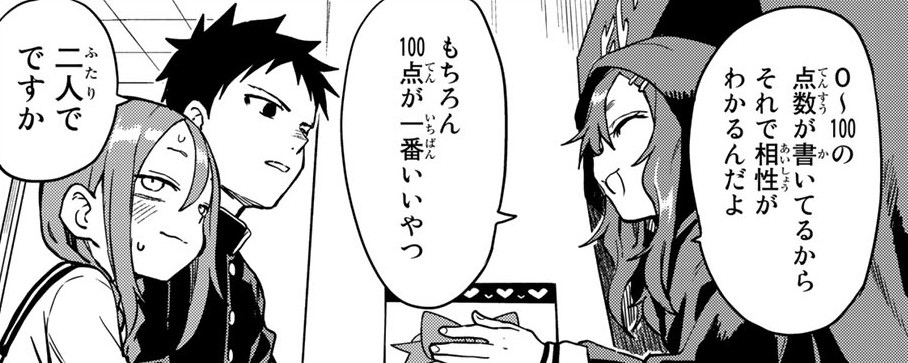
At the school festival, Ayumu and Urushi stop by the affinity fortune telling booth while Maki is on duty. Maki holds out a box with an opening on top, and says the need to pull out a single card together.
- マキ:
- 「0〜100の点数が書いてるからそれで相性がわかるんだよ」
- “Your compatibility is determined by the score written from 0 to 100.”
- 「もちろん100点が一番いいやつ」
- “Naturally, 100 points is the best.”
- 歩:
- 「二人でですか?」
- “Together?”
相手: Other party
相手 means the other party in an interaction: the person you face, deal with, or speak to. Depending on context, it can mean an opponent, a partner, a counterpart, or even “the person (you date / marry)”.
It combines 相 (other party) with 手 (hand) to show the person you deal with.
Keeping my dad company with 相手
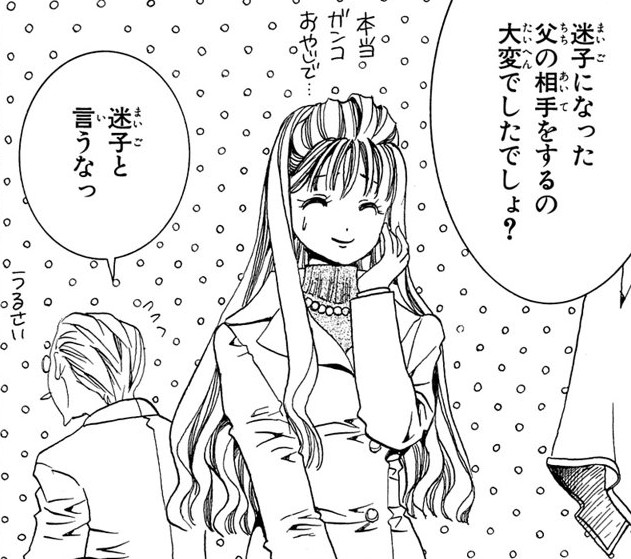
Akari encounters an older gentleman looking for a police box, so he can report his missing daughter and son-in-law. Akari offers to take him around and see if they can find the couple. Once they are reunited, the daughter thanks Akari for finding her father.
- 娘:
- 「迷子になった父の相手をするの大変でしたでしょ?」
- “It must have been tough dealing with my dad when he got lost, right?”
- 「本当ガンコおやじで…」
- “He really is a stubborn old man...”
- 父さん:
- 「迷子と言うなっ」
- “Don't say lost!”
- 「うるさい」
- “Annoying...”