Sinking and disappearing with 没
The etymology of 没 suggests a meaning of plunging beneath the surface of water. The core meanings are sink and submerge.
Things that sink below the surface become hidden and lost, giving 没 a broader sense of disappear and vanish. This extends to immersion in an activity (being fully plunged into it) and to death (a final disappearance from the world).
Etymology
This kanji is an associative compound comprised of 氵 (water) and 殳 (from an older kanji of a figure diving beneath the surface to retrieve something from below). These invoke imagery of a person plunging completely under the water, vanishing from sight.
The meaning of sink is direct from this imagery, going beneath the water’s surface and out of view. Just as something submerged becomes unseen, 没 takes on the broader sense of disappear. A celestial body disappearing below the horizon gives sunset (日没), and a person permanently disappearing from the world gives death. Plunging fully into something yields the sense of immerse, and making property disappear from its owner gives confiscate.
Common Words
没頭: Absorption
没頭 means to be completely absorbed in or devoted to something. It describes a state of deep focus where attention is fully immersed in a task or activity, to the exclusion of everything else. It takes する to form a verb.
It combines 没 (plunge) with 頭 (head) to show plunging one's head entirely into something.
Reading a book to distract from waiting for a text message with 気を紛らす
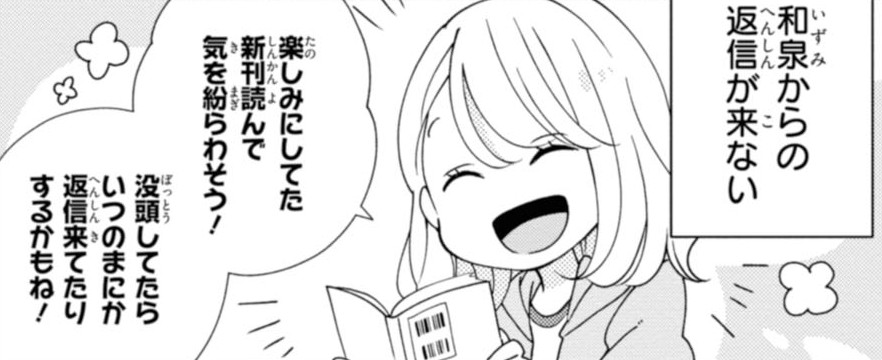
Akari is expecting a text message from Izumi. Unknown to her, Izumi’s response was getting too long, so he switched to his computer to write up an e-mail instead.
- Narration:
- 「和泉からの返信が来ない」
- “I haven't received a reply from Izumi.”
- あかり:
- 「楽しみにしてた新刊読んで気を紛らわそう!」
- “I'll distract myself by reading the new book I've been looking forward to!”
- 「没頭してたらいつのまにか返信来てたりするかもね!」
- “Maybe if I get really absorbed in it, the reply will show up before I know it!”
日没: Sunset
日没 means sunset, the moment the sun sinks below the horizon and disappears from view. It is a formal or literary term, used more in writing or announcements than in casual speech, where 夕暮れ or 夕方 are more common.
It combines 日 (sun) with 没 (sink) to show the sun sinking below the horizon.
An hour until sunset with 日没
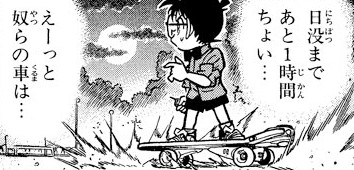
During a game of hide-and-seek in the park, Ayumi hides in the trunk of a car only to fall asleep. Since the car drove off a while ago, Conan plans to track Ayumi’s communication badge with his tracking glasses and follow the vehicle on his turbo-engine skateboard. Since the engine is solar-powered, he can only use it during sunlight.
- コナン:
- 「日没まであと1時間ちょい…」
- “Just over an hour until sunset.”
- 「えーっと 奴らの車は…」
- “Let's see, their car is...”
水没: Submersion
水没 means to be submerged or flooded under water. It is used for land, buildings, or objects that are inundated and sunk beneath the water’s surface, typically due to flooding, a dam, or rising water levels.
It combines 水 (water) with 没 (sink) to show something sunk beneath the water.
A submerged town with 水没
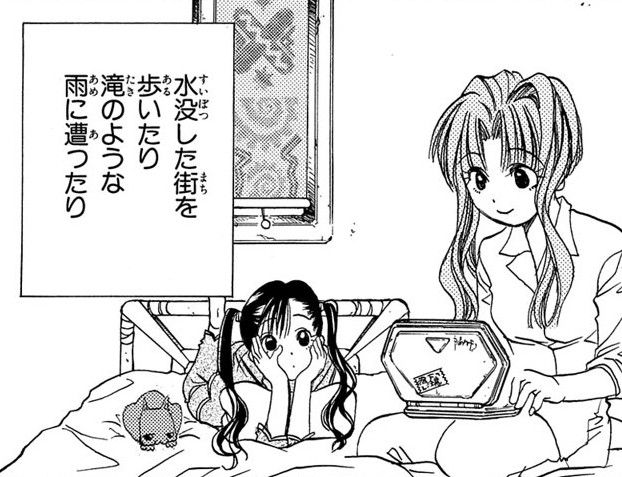
While out buying cat food during acqua alta, when tides have risen onto the streets, Akari is caught in a heavy downpour. She finds herself near Himeya Company, where her friend Aika lives, and she’s invited in to stay the night. As the two watch the falling rain through a window, Akari types an e-mail about her adventure that day.
- 灯里:
- 「水没した街を歩いたり滝のような雨に遭ったり」
- “Walking through a flooded town or getting caught in a downpour...”
She finishes by writing that it was a wonderful adventure and an enjoyable day.