Reflection and optics with 鏡
The kanji 鏡 has the concrete meaning of a mirror, a polished surface that throws back an image clearly.
From that physical sense, 鏡 naturally extends to lenses, glasses, and other optical devices used for seeing. Because a mirror also shows things plainly and can be looked to as a standard, the kanji further develops the figurative sense of a model or example.
Etymology
This kanji is a phono-semantic compound comprised of 金 (metal) as the semantic component and 竟 (end / complete) as the phonetic component, giving the on-reading キョウ. These invoke imagery of metal polished all the way to a finished, bright surface until it reflects a person’s form like a mirror.
Early mirrors were made from polished metal, so 鏡 first named a reflective object and then expanded to optical tools such as glasses, telescopes, microscopes, and scopes.
Common Words
眼鏡: Glasses
眼鏡 means glasses or spectacles. It refers to lenses worn in front of the eyes to improve vision, protect the eyes, or serve as a fashion accessory.
It combines 眼 (eye) with 鏡 (lens) to show lenses worn before the eyes for seeing.
Broken glasses with 眼鏡
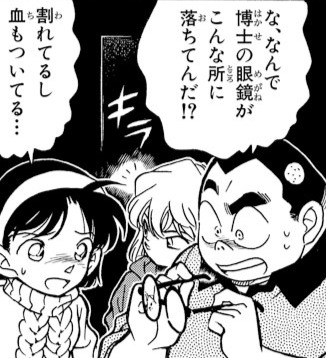
Professor Agasa and the Detective Boys stay overnight in a large villa in the woods after getting lost on a camping trip. Conan and Agasa go missing, leaving the rest of the kids to sneak around at night to search the property for them. After entering a secret passage, Haibana finds spots of blood on the ground, and then Genta finds Agasa’s glasses.
- 元太:
- 「な、なんで博士の眼鏡がこんな所に落ちてんだ!?」
- “W-what the heck? Why are the professor's glasses lying here!?”
- 歩美:
- 「割れてるし血もついてる…」
- “They're broken and there's blood on them...”
望遠鏡: Telescope
望遠鏡 means a telescope, an optical instrument for seeing distant things more clearly. It can refer to astronomical telescopes as well as general telescopes used to observe faraway scenes.
It combines 望遠 (look far into the distance) with 鏡 (lens) to show a device for seeing faraway things.
A comet-viewing telescope with 望遠鏡
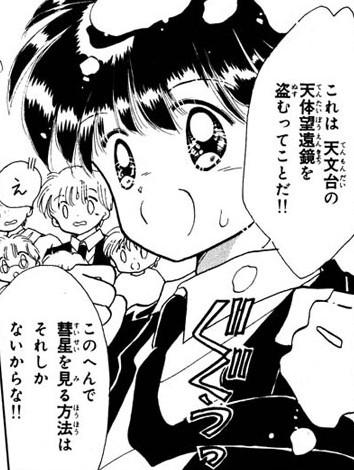
Asuka Jr. receives a challenge notice from Saint Tail, stating her intent to steal Graham Comet on Christmas Eve. One of his friends wonders how Saint Tail will steal a comet. Asuka Jr. thinks it over for a moment.
- アスカ Jr.:
- 「これは 天文台の天体望遠鏡を盗むってことだ!!」
- “That means stealing the observatory’s telescope!!”
- 「このへんで彗星を見る方法はそれしかないからな!!」
- “Since that’s the only way to see a comet around here!!”
双眼鏡: Binoculars
双眼鏡 means binoculars: a pair of optical lenses designed to be used with both eyes. They are used for watching distant scenery, wildlife, sports, or events.
It combines 双 (pair), 眼 (eyes), and 鏡 (lenses) to show paired lenses for both eyes.
A pair of binoculars among other items with 双眼鏡
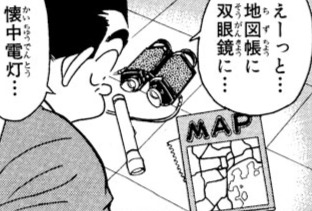
Ayumi leaves the bag with her new Masked Yaiba doll outside while she’s in the restroom. When she returns, she finds the bag waiting for her, but the doll is gone. Ran suggests someone may have taken her bag by mistake. Genta decides to see what’s in the bag Ayumi brought back, dumping its contents onto the ground.
- 元太:
- 「えーっと… 地図帳に双眼鏡に…」
- “Um... an atlas, binoculars...”
- 「懐中電灯…」
- “...a flashlight...”
手鏡: Hand mirror
手鏡 means a small handheld mirror used to check your face, hair, or appearance. It is the straightforward everyday sense of a mirror that you hold in your hand.
It combines 手 (hand) with 鏡 (mirror) to show a mirror held in the hand.
Protective hand mirror with 手鏡
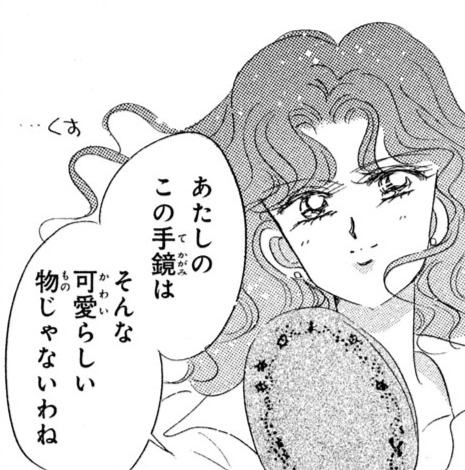
Seeing Chibausa leaving Hotaru’s house, Haruka and Michiru stop over to pick her up. Michiru asks what the two were talking about, and Chibausa explains that it was a conversation about amulets and their mysterious protective powers. She asks if Michiru has one. Michiru says her mirror may be protective, to which Chibausa says it must be an amulet.
- みちる:
- 「あたしのこの手鏡はそんな可愛らしい物じゃないわね」
- “This hand mirror of mine isn’t something that cute.”
万華鏡: Kaleidoscope
万華鏡 means a kaleidoscope, an optical toy or device that creates shifting symmetrical patterns through reflected pieces of light and color.
It combines 万 (ten thousand) and 華 (splendor) with 鏡 (mirror) to show a mirror device producing countless beautiful reflections.
A long-desired kaleidoscope with 万華鏡
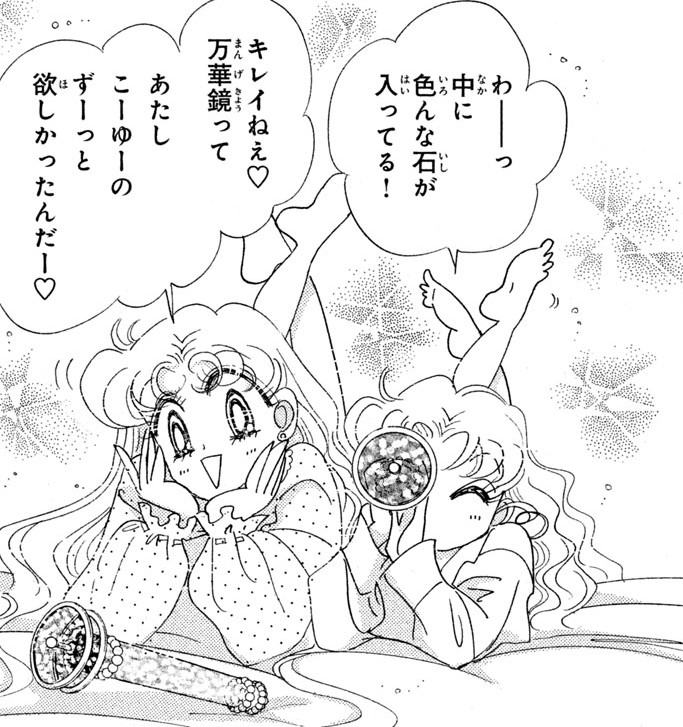
Usagi and Chibiusa look at the kaleidoscopes Mamoru bought them at the carnival.
- ちびうさ:
- 「わーーーっ 中に色んな石が入ってる」
- “Wow! There are all kinds of stones inside!”
- うさぎ:
- 「キレイねえ♡ 万華鏡って」
- “It's so pretty♡ A kaleidoscope...”
- 「あたし こーゆーの ずーっと 欲しかったんだー♡」
- “I've wanted one of these for so long♡”